
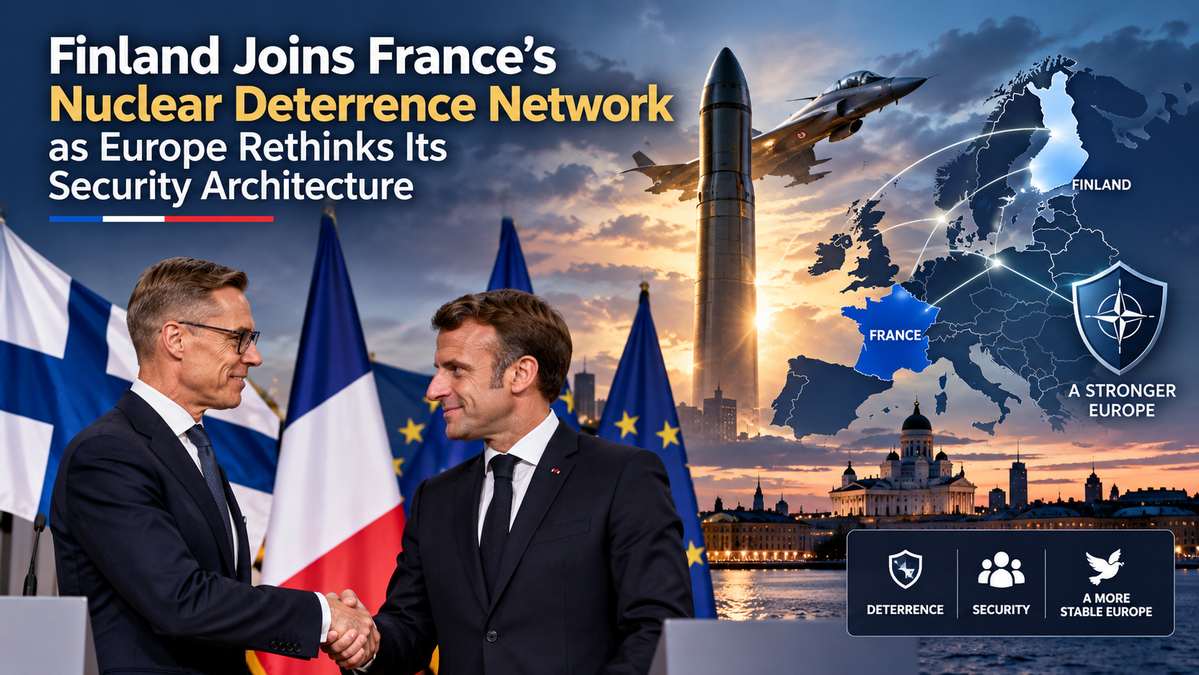
Europe’s nuclear security debate is entering a new phase. Finland has become the 10th European country to join France’s Forward Nuclear Deterrence Initiative, deepening military and strategic cooperation with Paris at a time when European governments are reassessing how the continent should prepare for a more uncertain security environment.
The move is significant because Finland shares a roughly 1,340-kilometer border with Russia and joined NATO only in 2023. Yet Helsinki has been careful to stress that cooperation with France is not a replacement for NATO’s nuclear deterrence, nor does it mean Finland is preparing to station nuclear weapons on its territory during peacetime.
Instead, the development points toward something broader: European countries are increasingly interested in having more than one channel through which they can discuss and strengthen deterrence.
What Finland Actually Joined
The French initiative was unveiled by President Emmanuel Macron in March 2026 as part of a broader effort to give Europe a stronger role in its own defense.
Finland formally joined the initiative on September 14. Under the agreement, the two countries will establish a Nuclear Steering Group to develop practical cooperation and strategic dialogue. The French presidency described the move as an important step for European security and bilateral cooperation.
The framework can involve strategic consultations, nuclear-related exercises and the potential temporary deployment of French nuclear-capable aircraft to allied territory.
But there is an important distinction.
France is not creating a shared nuclear arsenal with Finland. The French president retains sole authority over the use of French nuclear weapons.
That makes the arrangement fundamentally different from a system in which participating countries jointly control nuclear weapons.
Finland Still Sees NATO as Its Main Nuclear Framework
Finnish President Alexander Stubb has repeatedly emphasized that NATO remains central to Finland’s defense planning.
After the agreement with France, Stubb said the French initiative would add value to Finland’s defense planning rather than replace NATO’s nuclear deterrence.
That distinction matters.
Finland’s decision to join NATO followed Russia’s full-scale invasion of Ukraine and represented one of the biggest changes in the country’s security policy in decades. Helsinki is therefore not abandoning its Atlantic security relationship. Instead, it is adding another layer of cooperation with a European nuclear power.
Think of it less as changing the foundation of Finland’s defense policy and more as adding another supporting structure around it.
France Wants a Larger European Role
France has long maintained an independent nuclear deterrent as part of its policy of strategic autonomy.
Macron’s 2026 “forward deterrence” concept seeks to bring European partners into closer discussions surrounding that deterrent without surrendering French control.
The European Parliament’s research service describes the initiative as an effort to strengthen the European dimension of France’s nuclear posture while maintaining French sovereignty over nuclear decision-making.
That approach is particularly relevant as European governments debate how much responsibility they should assume for their own defense.
Russia’s war in Ukraine has already pushed European countries toward higher military spending and closer defense cooperation. At the same time, uncertainty surrounding the future scale and reliability of U.S. involvement in European security has encouraged discussions about greater European strategic capacity.
France is positioning its nuclear force within that conversation.
Ten Countries Are Now Involved
Finland joins nine other European countries participating in the French initiative: the United Kingdom, Germany, Poland, Sweden, the Netherlands, Belgium, Greece, Denmark and Norway.
The composition is noteworthy because these countries do not all have the same security policies or relationship with nuclear weapons.
Several are already covered by NATO’s nuclear deterrence arrangements. Germany, Belgium and the Netherlands also participate in NATO nuclear-sharing arrangements involving U.S. weapons.
The French initiative therefore does not simply create an alternative security alliance.
Instead, it creates another avenue for consultation and military cooperation involving France’s independent nuclear capability.
Estonia Could Be the Next Addition
The discussion is not necessarily stopping with Finland.
Estonian Prime Minister Kristen Michal has said Tallinn is in discussions with Paris about deeper cooperation in the nuclear field.
Estonia already relies on NATO’s collective defense arrangements and hosts French troops as part of the alliance’s forward presence in the Baltic region.
Michal’s comments suggest that Estonia is examining whether cooperation with France could add another element to its existing security framework rather than replace NATO.
Lithuania has also been examining its legal position on nuclear weapons, although that does not mean a decision has been made to host them.
These developments illustrate how countries on Europe’s eastern and northern flanks are examining different ways of strengthening deterrence.
Why Finland’s Decision Matters
Finland brings particular strategic weight to the initiative because of its geography.
Its long border with Russia places it directly on NATO’s northeastern flank. Finland also has extensive military experience, a large reserve system and growing defense cooperation with other European countries.
Its decision to participate therefore gives France’s initiative greater geographic relevance.
At the same time, Finland has placed clear limits on what the agreement means.
Stubb has said Finland does not intend to station nuclear weapons on its territory during peacetime. That means the immediate change is primarily about consultation, planning and strategic cooperation rather than the physical deployment of nuclear warheads.
This Is Not a European Nuclear Umbrella in the Traditional Sense
The phrase “French nuclear umbrella” is useful as shorthand, but it can also create the wrong impression.
NATO’s nuclear deterrence architecture involves the United States, Britain and France, while NATO itself maintains a Nuclear Planning Group. France, however, has traditionally kept its nuclear forces outside NATO’s nuclear-sharing structure.
Under Macron’s forward-deterrence concept, France retains national control.
That means European partners can participate in discussions and exercises, but they do not acquire authority over French nuclear weapons.
The European Parliament research service has similarly characterized the initiative as complementary to existing deterrence arrangements rather than a replacement for the U.S. nuclear guarantee.
A Broader Shift in European Defense Thinking
The most important development may therefore be less about the number of countries involved and more about the changing way European governments think about deterrence.
For decades, European security relied heavily on the United States and NATO. That structure remains in place, but governments are increasingly asking what additional capabilities Europe itself can provide.
France is trying to answer that question through its independent nuclear force.
Finland, meanwhile, is demonstrating that European countries can deepen cooperation with Paris while continuing to regard NATO as their primary defense framework.
The two approaches are not necessarily contradictory.
The Bigger Question Is What Comes Next
The next stage will determine how far the French initiative develops beyond political declarations.
The Nuclear Steering Groups and bilateral discussions will reveal whether participating countries want deeper exercises, more strategic consultations or greater involvement of French nuclear-capable forces in European defense planning.
France and Poland have already established a Nuclear Steering Group, showing that the initiative is moving toward practical bilateral mechanisms.
For Finland, the immediate priority remains conventional and collective defense through NATO. But participation in the French initiative gives Helsinki another channel for discussing the nuclear dimension of European security.
That may prove increasingly important as the continent prepares for a security environment in which old assumptions cannot simply be taken for granted.
Europe’s Nuclear Debate Is Becoming More Complicated
Finland’s decision does not mean Europe suddenly has a new shared nuclear arsenal.
What it does show is that Europe’s deterrence debate is becoming more layered.
NATO remains central. The United States remains a major part of the alliance’s nuclear posture. Britain maintains its own nuclear force. France continues to control its independent arsenal.
Now, however, more European governments are also willing to engage directly with France on nuclear deterrence and strategic planning.
That is perhaps the most important story behind Finland’s decision.
Rather than creating a new nuclear bloc overnight, Europe is gradually building additional links between national defense policies. Whether those links eventually produce a more integrated European deterrence framework—or remain complementary to NATO—will depend on decisions made in the years ahead.