
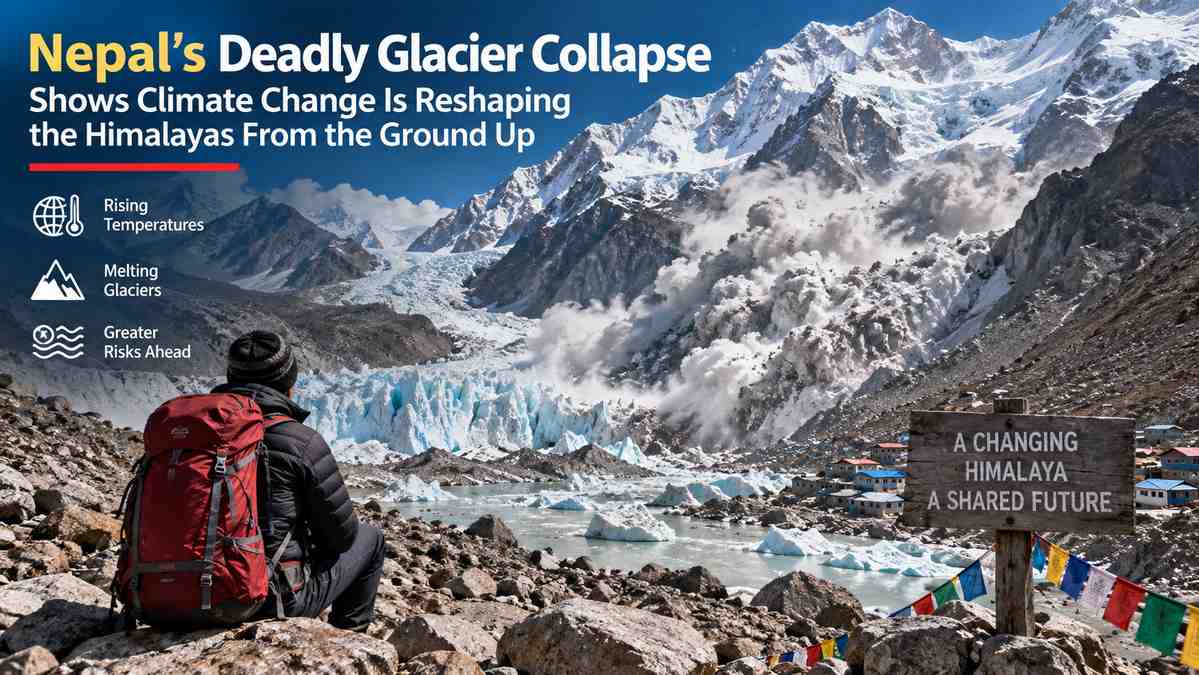
The devastating flood that swept through Nepal in August was not simply a flood.
It began high in the Himalayas, where a massive section of rock and glacier ice collapsed from a mountainside near Nepal’s border with China, unleashing a torrent of water, ice, boulders and debris that destroyed communities, roads, bridges and hydropower projects far downstream.
More than 1,300 people have been confirmed dead, while thousands remain missing. The disaster has become one of the deadliest mountain catastrophes in Nepal’s modern history.
Now, a new scientific analysis suggests that climate change likely played an important role—not by directly causing the collapse, but by slowly weakening the mountain over decades.
That finding changes the way we think about climate risks.
The danger is no longer limited to stronger storms or hotter summers.
In the Himalayas, climate change may also be changing the mountains themselves.
The Disaster Began Far Above the Valley
On August 26, a huge mass of rock and glacier ice broke away from the Langtang Lirung region near the Nepal-China border.
Scientists estimate that a large section of mountain, ice and debris detached and rushed downhill at tremendous speed, transforming into a destructive flood that moved through river valleys and populated areas below.
The force was extraordinary.
Entire sections of infrastructure disappeared. Hydropower plants were damaged. Roads and bridges were swept away. Communities located along river corridors had little time to react.
At first, attention focused on the immediate trigger.
But scientists wanted to understand a deeper question:
Why did the mountain become unstable in the first place?
Climate Change Did Not Act Alone
Researchers from the World Weather Attribution group, working with climate scientists and glaciologists, concluded that climate change likely increased the risk of collapse by contributing to long-term changes in glaciers and frozen ground.
However, the report also stressed that climate change was not the only factor.
The powerful earthquake that struck Nepal in 2015 may have weakened the mountain’s rock structure years earlier. Geological conditions, natural erosion and other environmental factors were also part of the story.
This is important because natural disasters are rarely caused by a single event.
They often result from several forces acting together over time.
Scientists describe this as a compound disaster—a chain of connected processes rather than one isolated trigger.
The Mountains Are Slowly Losing Their Frozen Support
One of the most significant findings in the analysis involves permafrost.
Permafrost is ground that remains frozen throughout the year. In high mountains, it acts like a natural cement, helping hold fractured rock together.
As temperatures rise, that frozen support begins to thaw.
Researchers found that the altitude at which ground remains permanently frozen has been moving upward by roughly 100 metres every decade in parts of the Himalayas.
That means areas that were frozen for hundreds or even thousands of years are gradually becoming unstable.
Imagine removing mortar from between bricks in a wall.
The structure may still stand for a while, but over time it becomes weaker and more vulnerable to collapse.
Scientists say something similar may now be happening in parts of the Himalayas.
Glaciers Are Retreating, and That Matters Too
The report identified another long-term change: glacier retreat.
Glaciers in the region have been shrinking for decades, losing more than half a metre of thickness per year on average. The Langtang Lirung glacier itself has retreated by around half a kilometre since the 1990s.
Glaciers do more than store ice.
They also exert pressure on surrounding rock walls.
As glaciers shrink, some of that support disappears.
At the same time, meltwater can seep into cracks, freeze, thaw and weaken rock further.
These processes occur slowly, often over decades.
But they can eventually produce sudden and dramatic results.
Record Heat Added More Stress
The timing may also have mattered.
Scientists found that July and August 2026 were the warmest such months recorded locally in the affected region.
Warmer temperatures accelerate glacier melt, increase thawing and can make mountain slopes more fragile.
Researchers emphasize that these changes do not necessarily trigger an immediate collapse.
Instead, they create conditions in which collapse becomes more likely.
This distinction is important.
Climate change may not determine exactly when a disaster occurs, but it can increase the chances that dangerous conditions develop.
A Warning for the Entire Himalayan Region
The implications extend far beyond one valley in Nepal.
The Himalayas contain more than 63,000 glaciers and feed major rivers that support billions of people across Asia.
Scientists warn that many glaciers and high-altitude areas are highly exposed to rising temperatures.
That means similar risks could exist elsewhere.
Communities, roads, hydropower projects and settlements are often concentrated in narrow mountain valleys—exactly where floodwaters and debris flows travel with greatest force.
The Nepal disaster therefore raises questions not only about climate change but also about how infrastructure is planned in high-risk mountain regions.
Early Warning Systems Have Limits
Nepal has invested in disaster preparedness and flood warning systems.
But researchers say this catastrophe exposed an important limitation.
Rainfall floods can often be forecast hours or days in advance.
Large mountain collapses are much harder to predict.
They can happen suddenly in remote regions where monitoring equipment is limited.
Scientists say improved satellite monitoring, better mapping of unstable slopes and more detailed observation of glaciers could reduce some risks.
However, they also caution that some hazards may exceed the ability of existing warning systems.
That presents a difficult challenge for countries dependent on mountain rivers and hydropower.
Nepal Contributes Little to Global Emissions, but Faces Huge Risks
Another aspect of the disaster has attracted attention internationally.
Nepal contributes only a very small share of global greenhouse gas emissions, yet it faces some of the most severe consequences of glacier melt and mountain instability.
This has renewed discussions about climate finance, adaptation support and international assistance for vulnerable countries.
For Nepal, rebuilding after the disaster could cost billions of dollars.
For many communities, recovery may take years.
The Bigger Story Is About Changing Mountains
Climate change is often discussed in terms of rising temperatures, stronger storms and sea-level rise.
The Nepal disaster points to another reality.
Mountains themselves are changing.
Glaciers are retreating.
Frozen ground is thawing.
Rock faces that remained stable for centuries may become less secure.
And in narrow valleys where people live, work and build infrastructure, those changes can have enormous consequences.
Scientists are careful not to say that climate change alone caused the tragedy.
But they say the evidence strongly suggests that global warming helped create conditions that made the collapse more likely.
That may be the most important lesson from Nepal.
Climate change is not only altering the atmosphere.
It is also slowly reshaping some of the world’s highest mountains—and communities living below them are increasingly feeling the consequences.