
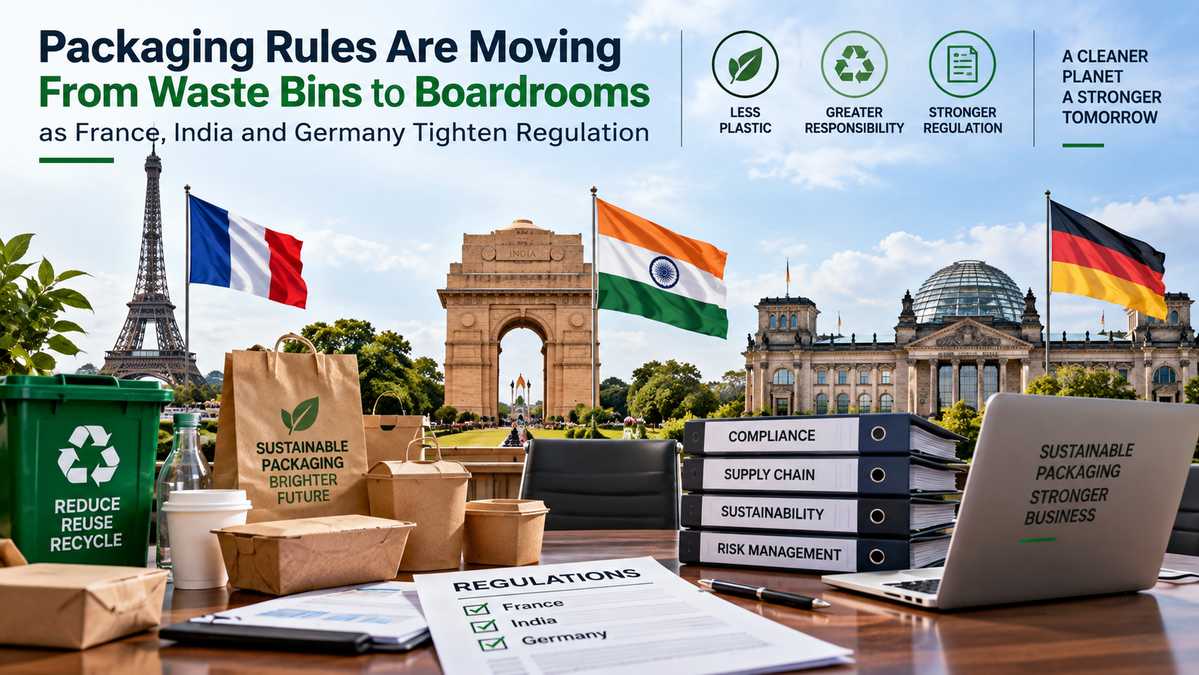
Packaging regulation is entering a new phase.
For years, companies could largely treat packaging sustainability as a question of materials, recycling symbols and corporate environmental commitments. That approach is becoming harder to maintain as governments introduce detailed rules covering what packaging is made from, how much recycled material it contains, who pays for its collection and how companies report what they place on the market.
France, India and Germany provide three particularly useful examples of this transformation.
Their systems are not identical, and there is no single global model for packaging regulation. France has built a broad producer-responsibility framework, India has placed strong emphasis on plastic waste and recycled content, while Germany has developed a highly structured system around registration, data and financing waste management.
The important change is happening underneath those differences: packaging is increasingly becoming a compliance issue that can influence product design, procurement and market access.
France Makes the Producer Responsible for More
France has developed one of Europe’s more extensive extended producer responsibility systems.
Its approach has been heavily influenced by the Anti-Waste for a Circular Economy law, known as AGEC, which strengthened producer obligations and introduced measures intended to reduce waste and encourage more circular product design.
One important element is France’s Unique Identifier, or IDU.
Companies covered by relevant EPR schemes must obtain an IDU, demonstrating their registration within the applicable producer-responsibility system.
This turns environmental compliance into a visible part of commercial activity.
For companies selling packaged products in France, packaging responsibility is therefore no longer something that begins when the product reaches a recycling facility. It can begin much earlier, with registration, reporting and packaging design.
France Also Puts Recycling Information on the Pack
French packaging rules extend into consumer information.
The Triman symbol and associated Info-tri system provide sorting information intended to help consumers understand what should happen to different product and packaging components after use.
That creates another challenge for international brands.
Packaging teams must consider mandatory sorting information alongside branding, product information and technical requirements.
France also uses eco-modulated EPR contributions, meaning environmental characteristics can influence what producers pay under applicable schemes.
In practical terms, better packaging design can therefore have both environmental and financial implications.
Professional Packaging Is Becoming Part of the EPR Picture
France is also expanding producer responsibility beyond conventional household packaging.
A new EPR framework covering professional packaging, including food-service packaging, is scheduled for implementation from January 1, 2027 after the original July 2026 launch was postponed.
The scale is significant. The French environment ministry estimates that around seven million tonnes of professional packaging are placed on the French market each year.
For packaging suppliers, this matters because business-to-business packaging is increasingly becoming part of the same regulatory conversation as consumer packaging.
Companies serving restaurants, food services, manufacturers and other professional customers will need to determine whether their products fall within the new obligations.
India Is Turning Plastic Rules Into Measurable Targets
India is approaching the challenge from a somewhat different direction.
Its packaging framework focuses heavily on plastic waste management, extended producer responsibility and the use of recycled plastic.
The Plastic Waste Management Rules, first introduced in 2016, have been amended repeatedly as India’s regulatory system has expanded.
A central EPR portal operated by the Central Pollution Control Board provides the infrastructure for registration and reporting by relevant producers, importers and brand owners, as well as plastic-waste processors.
The system is increasingly data-driven.
That means companies need to know not just that they use plastic packaging, but exactly how much they place on the market, what category it belongs to and how they are meeting their EPR obligations.
Recycled Content Is Becoming a Procurement Issue
One of India’s most significant developments is its increasing emphasis on recycled content.
The rules establish minimum recycled-plastic requirements for different categories of packaging, with targets rising over time.
For Category I rigid plastic packaging, for example, the target rises from 30% in 2025–26 to 40% in 2026–27, 50% in 2027–28 and 60% from 2028–29.
That changes the business calculation.
Recycled material is no longer simply something companies can use to strengthen an environmental claim. For businesses within the applicable rules, securing sufficient compliant recycled material can become part of meeting a regulatory requirement.
Packaging procurement and sustainability strategy are therefore becoming increasingly connected.
India’s Digital Approach Creates a Paper Trail
India’s centralized EPR system is also important because it creates a digital compliance structure.
Registration, reporting and waste-processing information can be managed through the regulatory platform.
For larger packaging users, this means data quality becomes increasingly important.
A company that cannot accurately track packaging quantities, materials and recycled content may struggle to demonstrate compliance.
The broader lesson is clear: packaging regulation is becoming a data-management problem as well as a materials problem.
Germany Built Packaging Compliance Around Data
Germany has taken yet another route.
The country has long operated a detailed packaging compliance system centered on producer responsibility and market transparency.
The LUCID Packaging Register, operated by the Central Agency Packaging Register, is a key part of that framework.
Businesses within scope must register and, where applicable, participate in systems that finance the collection and recycling of packaging.
Relevant packaging data must also be reported.
The model places considerable emphasis on knowing exactly what packaging enters the German market and who is responsible for it.
For companies operating internationally, that information can become just as important as the physical packaging itself.
Cross-Border Sellers Face Additional Requirements
Germany’s latest framework also has implications for companies selling directly to German consumers from abroad.
Since August 12, 2026, certain overseas producers without a German branch that sell empty packaging or packaged products directly to German end users must appoint an authorised representative for their EPR obligations.
However, the producer still has to complete its own LUCID registration.
This is particularly relevant to cross-border e-commerce.
A company does not necessarily need a factory in Germany for German packaging requirements to become part of its business planning.
Selling into the market can be enough to trigger obligations.
Europe’s New Rules Raise the Stakes
Germany’s developments cannot be separated from a much larger change across Europe.
The EU Packaging and Packaging Waste Regulation, or PPWR, began applying across the European Union on August 12, 2026. It creates a more harmonized framework covering packaging and packaging waste across the single market.
The regulation addresses areas including packaging design, recyclability, waste prevention, reuse and recycled plastic.
Some requirements are already applying, while others will arrive progressively.
From 2028, a harmonized packaging-labeling system is scheduled to apply across the EU. From 2030, additional measures concerning packaging waste prevention, reuse, recyclability and recycled plastic will take effect.
That means companies operating in Europe are entering a period of continuing regulatory change rather than a single compliance deadline.
The Three Countries Are Solving the Same Problem Differently
France, India and Germany have different regulatory philosophies, but their systems reveal several common trends.
France emphasizes producer responsibility, consumer information and eco-design.
India places greater emphasis on plastic waste, recycled content, EPR targets and digital reporting.
Germany focuses heavily on registration, traceability, data reporting and financing waste management.
None of these approaches is simply a copy of the others.
Yet all three push responsibility further upstream toward the companies that manufacture, import or sell packaged products.
That is an important change.
Instead of asking only, “Can this package be recycled?”, regulators are increasingly asking questions such as:
Who produced it? How much was placed on the market? What is it made from? How much recycled material does it contain? Who pays for its recovery? And can the company prove compliance?
Packaging Design and Compliance Are Moving Closer Together
The implications for product development could be substantial.
A packaging engineer may traditionally have focused on protection, shelf life, cost, appearance and manufacturing efficiency.
Environmental regulations are adding more variables.
Material choices can affect recyclability.
Recycled content can affect sourcing.
Packaging weight can influence environmental performance.
Labels can have to meet market-specific requirements.
EPR fees can create financial incentives around packaging design.
The result is a much more complicated design equation.
A package that performs perfectly from a technical perspective may still create regulatory challenges if it does not fit the requirements of a particular market.
One Package May Not Work Everywhere
Global brands face another problem: regulatory fragmentation.
Even as the EU works toward greater harmonization, national producer-responsibility systems remain important.
France has its own registration and labeling mechanisms.
Germany has LUCID and specific producer obligations.
India operates its own plastic EPR structure and recycled-content requirements.
This means a company selling the same product in multiple markets may need to manage different compliance processes.
The packaging itself may also need to change.
For smaller companies and cross-border sellers, these administrative differences can become a significant part of the cost of entering a new market.
The Real Race Is Toward Circularity
It is tempting to describe the development as a race between countries to create the strictest packaging laws.
But the more significant trend is broader.
Governments are attempting to move packaging systems away from a linear model—make, sell and discard—toward a circular system in which materials remain useful for longer.
That requires changes throughout the supply chain.
Manufacturers need different materials.
Brands need new packaging specifications.
Recyclers need suitable feedstock.
Retailers need compliant products.
Governments need reliable data.
Consumers need understandable sorting information.
Packaging regulation is increasingly connecting all of those pieces.
Businesses Need to Prepare Beyond the Next Deadline
The pace of regulatory change means companies cannot rely on checking requirements only when a new law comes into force.
Packaging data needs to be accurate.
Supplier information needs to be reliable.
Material specifications need to be documented.
Recycled-content claims need supporting evidence.
Companies selling internationally need to understand who carries producer responsibility in each market.
And packaging-development teams need to consider upcoming rules rather than designing only for today’s requirements.
The EU’s phased PPWR implementation demonstrates why this matters: some obligations are already applying while additional requirements arrive later.
Packaging Compliance Is Becoming a Business Strategy
France, India and Germany demonstrate three different approaches to the same global pressure.
France shows how extended producer responsibility can reach into registration, consumer information, eco-design and financial contributions.
India demonstrates how plastic regulation can be tied to measurable recycled-content targets and centralized digital reporting.
Germany illustrates how registration, data and producer-financed waste management can create a detailed compliance infrastructure, particularly for companies selling across borders.
The result is a fundamental shift in how packaging should be viewed.
It is no longer simply the material surrounding a product.
It is becoming part of the product’s regulatory identity.
For manufacturers, retailers and brands operating internationally, that means packaging decisions increasingly affect much more than appearance and cost. They can influence sourcing, product development, reporting systems, market access and long-term business planning.
The next stage of packaging regulation will therefore be less about simply putting more products into recycling bins and more about changing what companies put into the market in the first place.
That is the real significance of the regulatory developments underway in France, India and Germany.