
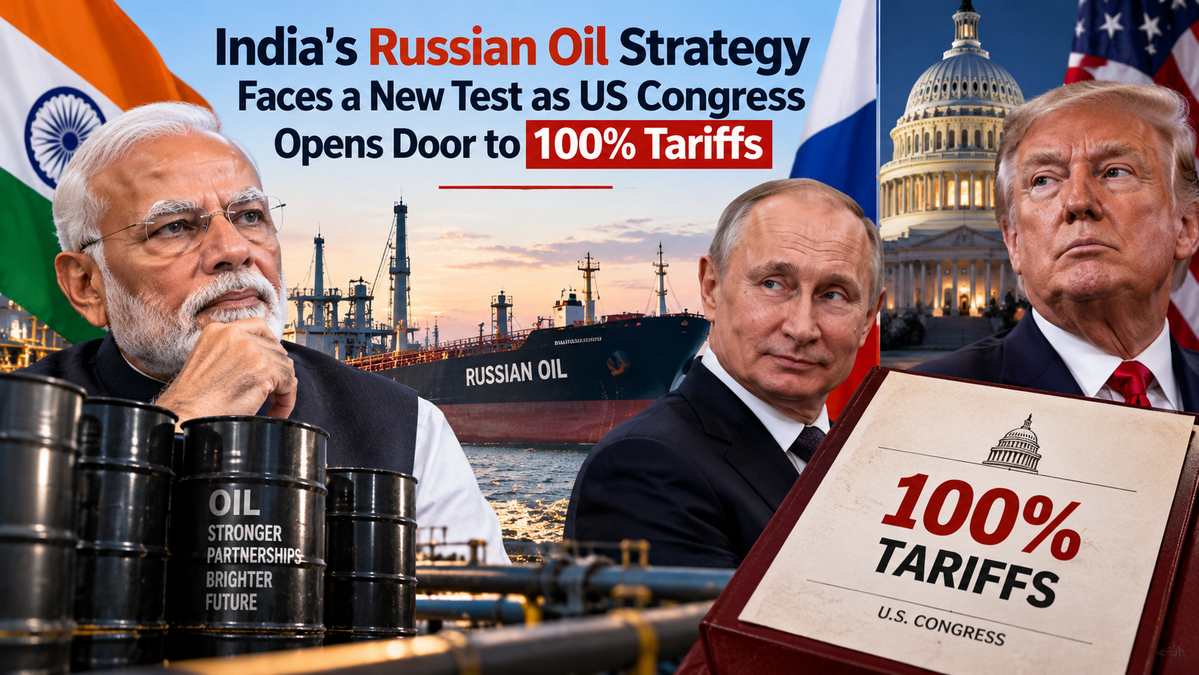
India’s Russian oil purchases have become the latest pressure point in its relationship with the United States.
The US House of Representatives has approved a sweeping Russia sanctions bill that gives President Donald Trump authority to impose tariffs of up to 100% on countries that continue to purchase Russian oil and gas under the conditions set out in the legislation. India and China are among the major buyers that could potentially be affected.
But there is an important distinction: the House vote does not itself impose a 100% tariff on Indian goods. The bill has been sent to President Trump, and any tariff would depend on the legislation becoming law and the administration deciding to use the authority it provides.
For New Delhi, however, the warning is already significant.
The issue is no longer just about where India buys its crude. It is about whether continuing to purchase discounted Russian oil could eventually carry a much larger price through India’s trade with the United States.
A New Chapter in the Russian Oil Dispute
The US House passed the legislation by 262 votes to 159 on September 16, following overwhelming Senate approval in August.
The measure is designed to increase economic pressure on Russia by targeting its energy and defense sectors, financial institutions and the networks used to circumvent existing sanctions. It also gives the president substantial authority to impose tariffs on countries continuing to rely on Russian energy.
The legislation is now before President Trump.
That means the immediate question has shifted from whether Congress will approve the framework to how the White House might use it.
Why India Is Vulnerable to the Measure
India is the world’s third-largest oil importer and has become one of Russia’s biggest crude customers since the war in Ukraine dramatically changed global energy trade.
Russian crude became particularly attractive to Indian refiners because it could be purchased at commercially favorable prices after Western sanctions disrupted Russia’s traditional European markets.
For India, the arrangement has helped diversify supplies and manage the cost of importing the enormous quantities of crude required by its economy.
Reuters reports that Indian refiners already have Russian oil arranged for September and October.
That makes an immediate and complete shift away from Russian supplies difficult.
The 100% Figure Needs Context
The headline figure is striking, but it needs to be understood correctly.
The legislation authorizes tariffs of up to 100%. It does not mean every Indian product entering the United States will automatically face a 100% duty the moment the bill becomes law.
The actual tariff would depend on the administration’s implementation of the legislation and the criteria applied to countries purchasing Russian energy.
This distinction matters for Indian businesses.
For now, they are facing the possibility of a much higher trade barrier rather than a confirmed universal 100% tariff.
Why India Cannot Treat Russian Oil Like an Ordinary Import
India’s dependence on imported crude makes the issue particularly sensitive.
Oil is not simply another product that can be replaced overnight.
Refineries have to secure appropriate grades of crude, arrange transportation and insurance, process the oil and then sell petroleum products into domestic and international markets.
Changing suppliers on a large scale can therefore affect refinery margins and fuel costs.
Indian refining sources cited by Reuters have warned that cutting Russian supplies while Middle Eastern oil flows are already disrupted could increase costs. Some refiners are seeking a transition arrangement that would allow existing purchases to be completed rather than facing an immediate cutoff.
India’s Answer: Diversify, Don’t Depend on One Supplier
New Delhi has emphasized that its energy policy is based on securing reliable supplies from different sources.
The Ministry of External Affairs said India remains firmly committed to energy security and will continue sourcing supplies from diverse sellers according to market conditions.
The government also said it would take measures to protect India’s trade and economic interests.
That approach gives India some room to adjust.
If Russian crude becomes less attractive because of sanctions, tariffs or shipping complications, Indian refiners can increase purchases from other producers.
But diversification does not necessarily mean that replacing Russian barrels will have no economic cost.
The Pressure Could Reach Indian Exporters
Perhaps the most important feature of the US approach is that the potential tariff would not simply punish India’s purchase of Russian oil.
It could affect Indian goods entering the American market.
That creates a chain reaction:
Russian oil purchases → possible US sanctions or tariffs → higher costs for Indian exports → pressure on Indian companies and trade negotiations.
This makes the issue much broader than the energy sector.
Indian manufacturers and exporters could potentially be affected even though their businesses have nothing directly to do with Russian crude.
India-US Trade Talks Add Another Layer
The timing is also significant because India and the United States are still working through trade issues.
Reuters reports that Indian analysts expect the new US tariff authority could complicate those negotiations. India’s Trade Minister Piyush Goyal is expected to travel to the United States later this month for the G20 trade ministers’ meeting, where discussions with US officials are expected.
That means Russian oil has become connected to a much wider economic conversation.
A disagreement over crude purchases could affect negotiations over market access, tariffs and other commercial issues.
Russia Remains Important, but So Does the US Market
India’s position is complicated because both relationships matter.
Russia is a major source of crude and an important long-standing partner.
The United States is also a major economic partner and an important destination for Indian exports.
This leaves New Delhi managing two separate but increasingly connected priorities.
On one side is the need for reliable and affordable energy.
On the other is the need to protect India’s access to major international markets.
The challenge is that a decision made in one area can now have consequences in the other.
Could India Simply Replace Russian Oil?
In theory, India has other suppliers.
The country buys crude from producers in the Middle East and other regions and has the world’s large refining capacity.
But replacing a major supplier is not simply a matter of finding another seller.
Price, crude quality, freight costs, insurance, refinery configuration and availability all matter.
And global oil markets are already facing additional disruption from geopolitical tensions.
Reuters reported that Indian refiners are concerned that losing Russian supplies in the current market could have a significant effect on their margins.
The timing therefore makes the decision more complicated.
China Faces Similar Pressure
India is not the only country caught in this dispute.
China is also a major purchaser of Russian oil and is included among the countries potentially exposed to the new US tariff mechanism.
The legislation is designed to make continued purchases of Russian energy more expensive for major buyers and thereby increase pressure on Moscow.
That could eventually reshape global oil flows if major Asian buyers begin reducing Russian purchases.
But it could also create competition for alternative crude supplies.
What Could Happen Next?
Several possibilities remain open.
India could gradually reduce its purchases of Russian crude while increasing supplies from other producers.
It could seek exemptions or transition arrangements from Washington.
Indian refiners could continue existing purchases while waiting for clearer rules from the US administration.
Or the White House could decide to use the new tariff authority more aggressively.
The eventual outcome will depend on the final implementation of the legislation, US-India negotiations and developments in the global oil market.
The Bigger Issue Is Energy Security
The debate reveals a broader reality about India’s economy.
India’s energy policy cannot be separated completely from geopolitics.
A refinery buying crude is making a commercial decision, but that decision can now trigger questions about sanctions, trade policy and international relations.
Russian oil became attractive partly because the global energy system was reshaped by the war in Ukraine.
Now that same energy relationship is creating a new challenge for India.
The question is not simply whether Russian oil is cheaper.
It is whether the discount remains valuable after accounting for the potential cost of losing access to important markets or facing higher trade barriers.
India Faces a Complicated Calculation
The US House vote has not suddenly placed a 100% tariff on every Indian export.
What it has done is create a much stronger potential mechanism for Washington to pressure major Russian-energy buyers.
That puts India’s Russian-oil strategy under greater scrutiny.
New Delhi must now weigh three interconnected interests: keeping energy supplies reliable, maintaining economically viable oil imports and protecting India’s wider trade relationship with the United States.
For Indian policymakers and refiners, the next stage will be about finding room between those competing pressures.
The most important question may therefore not be whether India will stop buying Russian oil tomorrow.
It is whether India can gradually diversify its energy sources without allowing the transition to create a larger economic shock at home or a deeper trade dispute with Washington.
That is the calculation now unfolding behind the headline about a possible 100% tariff.