
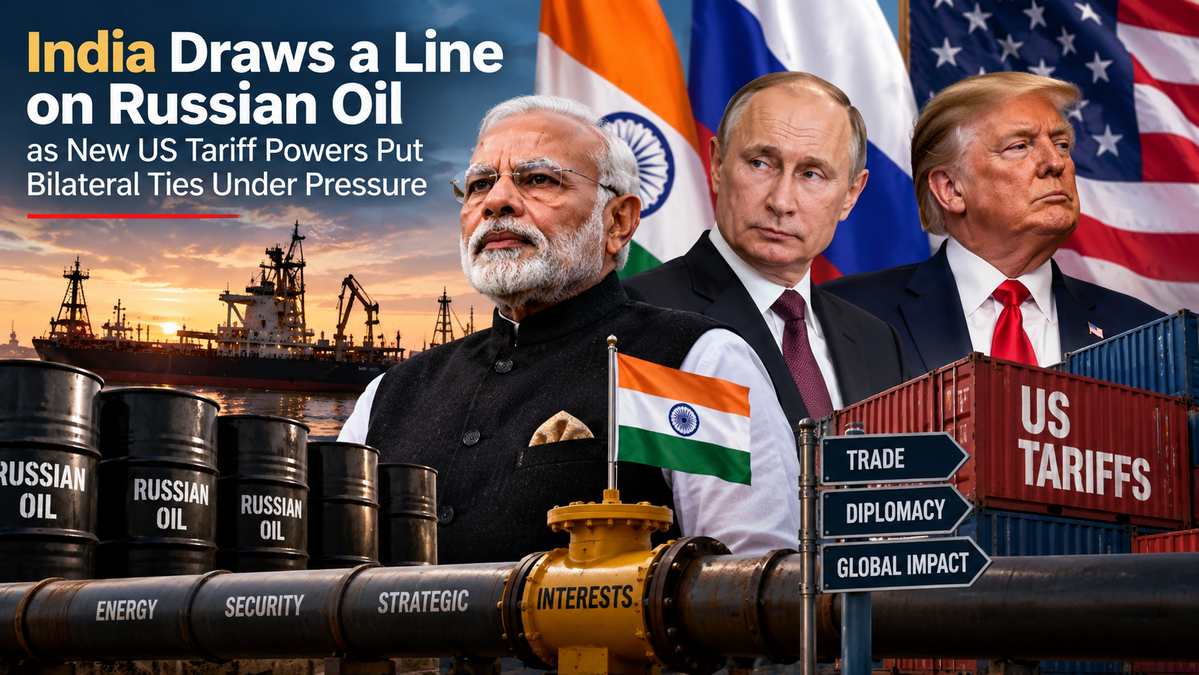
India’s relationship with the United States has entered a more complicated phase after New Delhi warned that new US measures targeting buyers of Russian oil could have consequences for bilateral ties.
The warning came after the US House of Representatives passed a sweeping Russia sanctions bill that gives President Donald Trump authority to impose tariffs of up to 100% on countries including India and China over their continued purchases of Russian energy.
The legislation has now been sent to Trump for his signature. Importantly, the House vote does not mean India has automatically been hit with a 100% tariff. It creates the authority for the US president to impose such tariffs if the legislation becomes law and the administration chooses to use those powers.
For New Delhi, however, the issue has already moved beyond a debate about crude oil.
It is becoming a question of how far pressure over Russian energy can go before it begins affecting the wider India-US relationship.
India Says Energy Security Comes First
India’s Ministry of External Affairs said Thursday that the country remains firmly committed to securing energy supplies for its 1.4 billion people.
The government said it would continue to source energy from diverse suppliers according to changing market conditions.
At the same time, New Delhi said it had repeatedly discussed the proposed US measures with American officials and had clearly explained their potential consequences for both bilateral relations and international energy markets.
The message is significant.
India is signaling that Russian oil purchases are being viewed primarily through the lens of energy security and economic interests, rather than solely through Washington’s Russia policy.
The 100% Tariff Is a Possibility, Not a Reality Yet
The headline figure has attracted considerable attention, but the details matter.
The US legislation authorizes President Trump to impose tariffs of up to 100% on countries that continue to rely on Russian oil and gas under the law’s provisions.
It does not automatically place a 100% duty on Indian exports.
The bill passed the House 262-159 after receiving strong bipartisan support in the Senate, where it passed 86-11. It now awaits Trump’s signature.
That leaves an important period in which Washington and New Delhi can assess the economic and diplomatic consequences.
For Indian businesses, though, even the possibility of such tariffs creates uncertainty.
Why Russian Oil Matters So Much to India
India is the world’s third-largest oil importer and has become one of the biggest buyers of Russian crude since Western sanctions transformed global energy markets after Russia’s full-scale invasion of Ukraine in 2022.
Russian oil became commercially attractive to Indian refiners as Moscow redirected supplies away from traditional European markets.
For India, purchasing Russian crude has helped diversify its supply sources and secure large volumes of energy for a rapidly growing economy.
That is why New Delhi has repeatedly resisted demands to simply abandon the trade.
India’s argument has been consistent: a country with a huge population needs energy that is secure, reliable and economically viable.
Washington Sees the Same Oil Trade Differently
The United States views Russian energy revenue through a different lens.
Washington’s sanctions strategy is designed to reduce the money flowing to Moscow from oil and gas exports and thereby increase economic pressure over the war in Ukraine.
The new legislation goes beyond Russia itself.
It also targets the countries that continue to purchase significant amounts of Russian energy by giving the US president the potential to impose steep tariffs on their exports to the United States.
That approach effectively turns access to the US market into a potential lever over other countries’ energy decisions.
The Pressure Could Reach Far Beyond Refineries
This is what makes the latest development particularly important for India.
The potential US tariff would not simply make Russian oil more expensive for Indian refiners.
It could affect Indian products entering the American market.
That means a dispute that begins with crude oil could eventually reach manufacturers, exporters and other businesses that have no direct connection to the Russian energy trade.
The economic chain could look very different from a conventional oil sanction:
Russian oil purchases → US pressure → possible tariffs on Indian goods → higher costs for Indian exporters → broader economic consequences.
That is why New Delhi has described the issue as one affecting the bilateral relationship rather than merely the energy sector.
India Is Keeping Its Options Open
India’s response also leaves room for flexibility.
The government says it will continue sourcing energy from diverse sellers and will base purchasing decisions on evolving market conditions.
That means New Delhi does not necessarily have to choose between maintaining all Russian oil purchases and abandoning them completely.
It can adjust the balance among suppliers depending on prices, availability, shipping costs, sanctions requirements and broader economic conditions.
This flexibility could become increasingly important if Washington eventually activates the new tariff authority.
Replacing Russian Oil Would Not Be Cost-Free
India has alternative suppliers.
Middle Eastern producers, the United States and other oil-producing countries can provide crude to Indian refiners.
But replacing a major source of supply is not simply a matter of signing new contracts.
Crude quality, refinery configuration, freight costs, insurance and availability all influence the economics.
The wider oil market is also facing geopolitical disruption, with crude prices recently remaining above $100 a barrel even as some immediate fears about Middle Eastern supply disruptions have eased.
If India and other large buyers simultaneously seek more non-Russian crude, competition for alternative supplies could increase.
That could raise the cost of diversification.
The International Oil Market Could Also Feel the Effects
The consequences may not stop at India’s borders.
If major buyers reduce purchases of Russian oil, Moscow would need to find alternative customers or accept lower revenues.
At the same time, countries replacing Russian barrels would have to compete for supplies from other producers.
Oil could therefore be rerouted across the global market.
Tankers could travel different routes. Refiners could change crude blends. Suppliers could redirect cargoes between regions.
The result would be a reshuffling of the global oil map rather than simply the disappearance of Russian crude from international trade.
China Is Facing Similar Pressure
India is not the only major Russian-oil customer affected by the US legislation.
China is also among the world’s largest buyers of Russian energy and could face similar tariff pressure.
That makes the measure potentially much larger than a bilateral dispute between Washington and New Delhi.
If both major Asian buyers were pushed to reduce Russian purchases, the effects could spread through global crude markets.
On the other hand, if both countries continue buying Russian energy, the United States would have to decide how aggressively to use the tariff powers provided by Congress.
A Difficult Balancing Act for New Delhi
India now has several interests to protect simultaneously.
It needs affordable and reliable energy.
It wants to preserve its relationship with Russia.
It has major economic and trade interests in the United States.
And it wants to avoid unnecessary disruption to global oil markets.
Those priorities do not always point in the same direction.
Reducing Russian oil purchases could ease pressure from Washington but potentially increase India’s energy costs.
Maintaining purchases could preserve access to attractive crude supplies but increase the risk of trade friction with the United States.
That is the calculation confronting policymakers.
Why India’s Latest Warning Matters
The wording from New Delhi is notable because it does not simply reject the US legislation.
Instead, India says it has already communicated the possible implications for the bilateral relationship and the international energy market.
It has also stressed that it will take measures necessary to protect its trade and economic interests and work with trade and industry groups as the situation develops.
That suggests India is preparing for multiple possible outcomes rather than assuming that the worst-case tariff will automatically be imposed.
What Happens Next?
The immediate decision now rests with Washington.
The House has passed the sanctions legislation, and the Senate has already approved it. President Trump must now decide whether to sign it into law.
If it becomes law, another question follows: will the administration actually impose the maximum 100% tariff, apply a lower rate, seek exemptions or negotiate another arrangement with affected countries?
For India, those details could matter enormously.
The difference between a threat, a negotiated transition and an actual 100% tariff would be substantial for exporters, refiners and the wider economy.
The Bigger Story Is India’s Strategic Balancing Act
The Russian-oil dispute is exposing a larger reality in India’s foreign economic policy.
New Delhi wants to maintain strategic relationships with several major powers without allowing any single relationship to dictate its energy or trade decisions.
Russian crude has become an important part of that strategy because it offers another source of supply.
The United States, meanwhile, is using access to its enormous consumer market as part of its pressure campaign against Russia’s energy trade.
That creates a collision between two different priorities.
For India, the challenge is to protect energy security while minimizing disruption to its trade relationships.
The latest warning from New Delhi shows that it is prepared to defend that position.
The question now is how Washington responds—and whether the two countries can prevent a dispute over Russian oil from developing into a much broader economic confrontation.
For now, the 100% tariff remains a potential US tool rather than an automatic punishment on India. But the fact that such a tool is now moving closer to becoming law has already changed the calculations on both sides.