
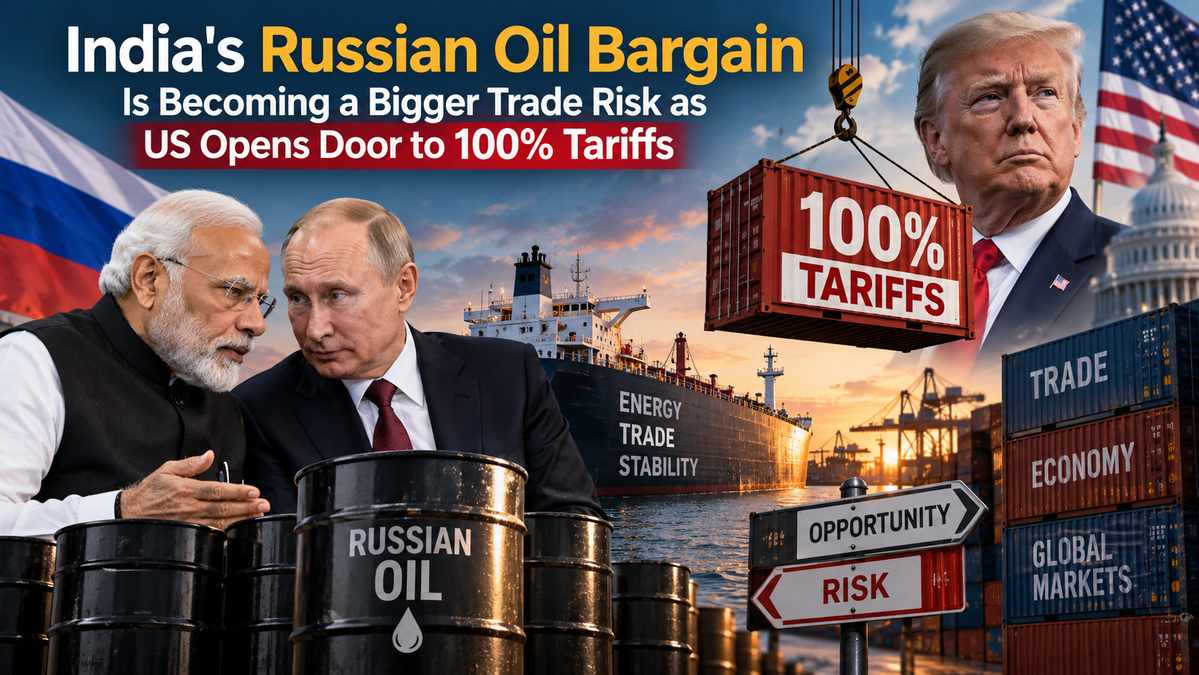
For the past four years, India’s relationship with Russian oil has been built around a straightforward calculation: buy large volumes of crude at attractive prices, keep energy supplies diversified and reduce the cost of one of the country’s biggest imports.
That calculation is becoming much harder.
The US House of Representatives has passed legislation that would give President Donald Trump broad powers to impose tariffs of up to 100% on major buyers of Russian oil and gas, including India and China. The measure has now been sent to Trump after clearing the House by 262 votes to 159 and the Senate by 86 to 11 last month.
But there is an important distinction behind the headline.
India has not automatically been hit with a 100% tariff. The legislation creates the authority for the US president to impose tariffs of up to that level if its provisions are used. What Trump ultimately does, and at what rate, remains crucial.
For New Delhi, however, the warning is already forcing a difficult question: How much is the Russian-oil discount worth if keeping those purchases puts India’s exports to the United States at risk?
How Russian Oil Became So Important to India
Russia was not always such a dominant supplier to India.
The picture changed dramatically after Russia’s full-scale invasion of Ukraine in 2022 and the resulting Western sanctions disrupted established global oil flows.
Russian crude that had previously gone to European markets was redirected toward countries such as India and China.
Indian refiners took advantage of the opportunity.
The result was a dramatic increase in Russian crude imports. According to figures cited by the BBC, Russian oil represented about 30.3% of India’s crude imports in fiscal 2026, worth approximately $40.8bn. In July, Russia supplied more than half of India’s crude imports.
For India, the arrangement provided another major source of crude at a time when energy security remained a central concern.
The Russian-Oil Discount Came With a Benefit
The economics were particularly attractive in the early years of the trade.
Indian refiners could purchase Russian crude at discounts created by Western sanctions and restrictions on Moscow’s traditional markets.
That helped improve refinery economics and gave India greater flexibility in managing its huge crude-import bill.
The BBC reports that India’s shift toward Russian crude has generated estimated savings of about $12.6bn since 2022, according to the Council on Energy, Environment and Water.
But the economics are changing.
The discounts have narrowed, while shipping, insurance and sanctions-related risks have increased.
That means the financial advantage of Russian crude cannot be considered separately from the potential cost of continuing to buy it.
The US Is Targeting the Trade Through Tariffs
The new American approach is significant because Washington is not simply trying to punish Russian companies.
It is also seeking to influence the behavior of countries that continue buying Russian energy.
The legislation targets Russia’s energy and defense industries and its so-called “shadow fleet” of tankers used to move oil outside existing sanctions systems.
At the same time, it gives the president authority to impose tariffs of up to 100% on major Russian-energy buyers.
This creates a very different kind of pressure.
The potential cost for India would not primarily arrive at the refinery gate.
It could arrive through Indian exports to the United States.
Why a Tariff on Indian Goods Matters
The United States is an important market for Indian companies.
According to figures cited by the BBC, the US imported about $104bn worth of goods from India in 2025, while two-way US trade in goods and services was around $240bn. Indian exports to America include electronics, pharmaceuticals, machinery, chemicals, jewellery, textiles and petroleum products.
A very high tariff could therefore affect businesses far removed from the oil industry.
An Indian electronics manufacturer, pharmaceutical company or textile exporter could potentially face higher costs in the American market because of a dispute that began with India’s purchase of Russian crude.
That is what makes the current situation particularly complicated.
India Has Not Accepted Washington’s Premise
New Delhi has repeatedly emphasized that its oil purchases are driven by energy security and commercial considerations.
India imports more than 88% of the crude oil it consumes, making overseas supplies essential to the country’s economy.
The Ministry of External Affairs said India remains firmly committed to securing energy for its population and will continue sourcing supplies from diverse sellers according to market conditions.
It also said Indian officials had discussed the implications of the US legislation with American counterparts and had made clear that New Delhi would take necessary measures to protect its trade and economic interests.
That response suggests India is preparing for several possible outcomes rather than assuming that the maximum tariff will automatically be imposed.
Replacing Russian Oil Would Not Be Simple
India does have alternatives.
The country buys crude from the Middle East, the United States, Latin America and other suppliers.
But replacing Russian oil on a large scale could be expensive.
Different crude grades can require adjustments in refinery operations. Freight costs vary by origin. Insurance can become more expensive when shipping routes pass through unstable regions.
And the global oil market itself is currently facing geopolitical disruption.
Indian refiners have reportedly asked the government to seek flexibility from Washington, including arrangements that could allow existing Russian-oil transactions to be completed and potentially establish a transition period rather than forcing an immediate cutoff.
There Is Another Complication: India’s Refineries Export Fuel
India is not merely a consumer of crude.
Its large refining industry processes imported oil into petrol, diesel and other petroleum products, some of which are exported.
That creates another link between Russian crude and international trade.
The BBC reports that Indian refineries supplied about 70% of Russia’s oil-product imports in August, illustrating how the energy relationship now works in both directions.
A change in Russian crude supplies could therefore affect not only India’s crude-import bill but also refinery margins and petroleum-product trade.
The Timing Makes the Situation More Sensitive
The tariff threat comes while India and the United States are still working through broader trade negotiations.
That makes the Russian-oil issue part of a much larger economic conversation.
Indian analysts cited by Reuters have warned that the new US tariff authority could complicate the negotiations and potentially make a broader trade agreement harder to conclude. India’s Trade Minister Piyush Goyal is expected to meet US officials during the upcoming G20 trade ministers’ meeting.
The outcome could therefore affect much more than the price India pays for crude.
India Has Some Protection, but Not Complete Protection
India has been working to diversify both its energy suppliers and its trading partners.
That provides some room to absorb external shocks.
But the country remains heavily dependent on imported crude, and its oil supply is concentrated among a relatively small group of suppliers.
The BBC cites analysis showing that more than 85% of India’s crude comes from six countries, while strategic petroleum reserves cover only a limited period of net imports.
That makes a sudden disruption potentially expensive.
The Russian supply relationship has therefore provided India with more than cheaper oil. It has also been another source of supply in an increasingly uncertain global energy market.
China Is Facing the Same US Pressure
India is not the only major Russian-oil buyer caught in the new American strategy.
China is Russia’s largest crude customer, accounting for about half of Russian crude exports between December 2022 and August 2026, according to figures cited by the BBC. India accounted for about 37%.
If both countries were to significantly reduce Russian purchases, global oil flows could change substantially.
Russia would need to find alternative markets, while India and China would compete for more crude from other producers.
That could have consequences for international oil prices and shipping.
The Real Calculation for New Delhi
The central issue can now be expressed in one question:
At what point does the economic benefit of Russian oil become smaller than the potential cost of US trade restrictions?
There is no fixed answer.
It depends on the Russian crude discount, global oil prices, freight and insurance costs, the eventual US tariff rate and whether Washington provides exemptions or transition arrangements.
A 100% tariff would produce a very different calculation from a lower tariff.
A negotiated exemption would produce another.
And a gradual reduction in Russian purchases would be different again.
The House Vote Changes the Pressure, Not the Final Outcome
The latest US vote is significant because it moves the potential tariff mechanism closer to becoming law.
But it is important not to overstate what has happened.
The House has not imposed a 100% tariff on India. It has approved legislation that would give President Trump the authority to impose tariffs of up to 100% on major buyers of Russian energy. The bill now awaits the president’s action.
That leaves space for diplomacy.
It also leaves Indian policymakers with difficult decisions about energy purchases, trade negotiations and economic risk.
The Bigger Story Is No Longer Just About Oil
India’s Russian-oil strategy began as an energy-market response to a major geopolitical shock.
Now it has become part of another geopolitical calculation.
Russian crude can help India maintain energy supplies and, under favorable conditions, reduce import costs.
But continued purchases could expose Indian exporters to additional pressure from Washington.
That means the value of Russian oil can no longer be measured only by the price of a barrel.
Its real cost may also include shipping risks, insurance, sanctions exposure, trade uncertainty and access to the US market.
For India, the next stage will be about balancing all of those factors at once.
The central question is therefore not simply whether New Delhi will continue buying Russian oil.
It is whether India can preserve the energy benefits of diversified crude supplies while preventing an oil dispute from turning into a much broader trade confrontation with one of its most important economic partners.